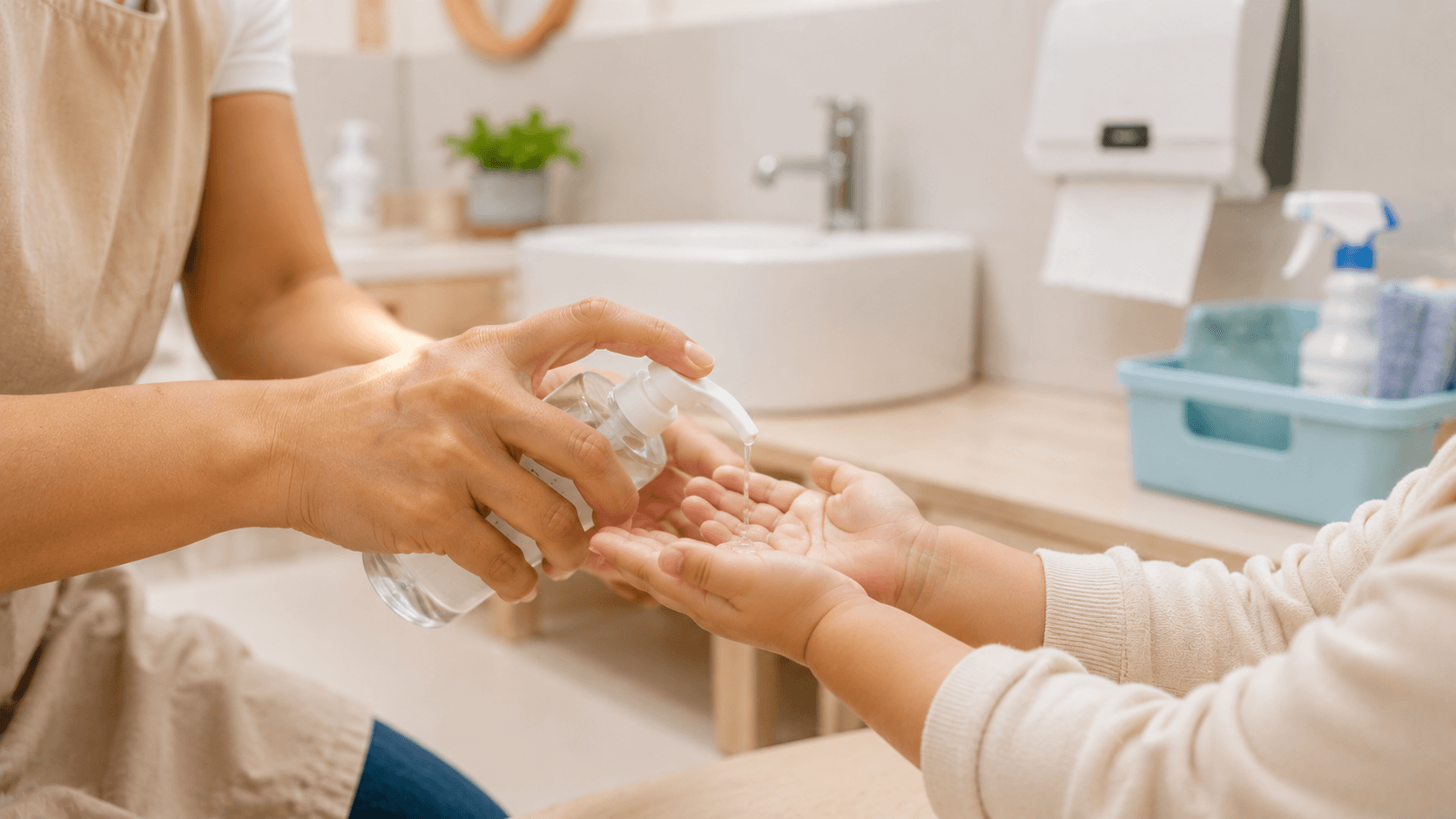
When you leave your child at nursery, you are trusting that they will be safe, healthy, and well cared for every minute of the day. The UAE has established clear health and safety requirements for nurseries, grounded in Federal Decree Law No. 51 of 2022 and enforced by emirate-level regulators. Understanding these standards helps you evaluate nurseries with confidence and hold them accountable. This guide covers every major health and safety requirement, from staff ratios to food hygiene to what happens when your child is unwell, so you know exactly what to expect and what to demand.
Staff-to-Child Ratios
Ratios are the single most important safety standard in a nursery. They determine how much individual attention your child receives and how quickly staff can respond in an emergency.
| Age Group | Required Ratio | What This Means |
|---|---|---|
| Under 12 months | 1:3 | One adult for every three babies |
| 12 to 24 months | 1:4 to 1:5 | One adult for every four to five toddlers |
| 2 to 3 years | 1:6 to 1:8 | One adult for every six to eight children |
| 3 to 4 years | Up to 1:10 | One adult for up to ten children |
These ratios must be maintained throughout the day, including during nap times, outdoor play, and meal times. They are not just about having enough adults in the building: they are about having enough adults in each room.
How to verify: During your nursery visit, count the children and adults in each room. If you see 12 toddlers and two adults in a room for 12 to 24 month olds, the ratio is 1:6, which exceeds the required 1:4 to 1:5. Ask about it.
Space Requirements
Children need room to move, play, and learn safely. ADEK health and safety requirements specify:
- Under 2 years: 3.5 square metres per child
- Over 2 years: 3.0 square metres per child
- Building location: Nurseries must be on the ground floor or first floor: higher floors are not permitted
These are minimum standards. A nursery that meets them exactly will feel adequate. One that exceeds them will feel spacious and comfortable. One that falls short will feel cramped. Trust your instinct.
On-Site Clinic and Medical Provisions
The UAE's requirements around on-site medical provision have evolved. Here is the current position:
The DHA Opt-Out Provision
The Dubai Health Authority now allows nurseries to opt out of having an on-site nurse if they meet three conditions:
- At least 10% of staff hold valid first aid certificates (BLS/CPR)
- Parents are informed that there is no nurse on site
- The nursery does not accept chronically ill children
This means a nursery without a nurse is not necessarily non-compliant, but you should verify that adequate first aid coverage is in place.
Isolation Room
Every nursery must have a designated isolation room for children who become unwell during the day. Requirements include:
- Separate ventilation (to prevent spread of illness to other children)
- Easy-clean surfaces
- Proximity to a bathroom
- Comfortable resting space
If a nursery does not have an isolation room, ask where they care for sick children while waiting for pickup. "We just keep them in the classroom" is not an acceptable answer.
Vaccination Requirements
The UAE requires all children to be fully vaccinated before nursery enrolment, following the same schedule as schools. Vaccinations are free at government health centres for all children, and records are tracked through the Al Hosn app.
The standard schedule includes BCG and Hepatitis B at birth, Hexavalent and Rotavirus doses at 2, 4, and 6 months, MMR and Varicella at 12 months, and booster doses at 18 months and 4 to 6 years.
If your child was vaccinated abroad on a different schedule, visit a government health centre to have the record reviewed and any missing vaccinations administered before enrolment.
Food Safety Standards
Nurseries that provide meals must follow HACCP (Hazard Analysis and Critical Control Points) food safety standards:
- Refrigerators must be maintained below 5 degrees Celsius
- Food warmers must be maintained above 63 degrees Celsius
- Both must be checked and logged twice daily
- ADEK requires nurseries to include weekly Emirati dishes and locally sourced seasonal produce in menus
- Allergen-free zones with designated utensils must be maintained for children with allergies
Ask to see the temperature logs during your visit. A nursery that maintains these logs consistently takes food safety seriously. One that cannot show them may not.
Allergen management is particularly important. Ask how the nursery handles nut allergies, dairy intolerances, and other dietary requirements. A clear policy should be in writing and understood by all staff, not just the kitchen team.
Illness Policies
The standard illness policies in UAE nurseries include:
The 48-Hour Rule
Children must stay home for a minimum of 48 hours after vomiting or diarrhoea. This is non-negotiable and protects all children in the nursery from infectious illness.
Temperature Policy
A child with a temperature of 37.5 degrees Celsius or above is sent home. They must stay home until their temperature has been normal for 24 to 48 hours. A doctor's note may be required before return.
Antibiotics
A minimum of 24 hours exclusion after starting antibiotics. This allows the medication to take effect and reduces the risk of passing infection to other children.
These policies can feel frustrating when you are a working parent: a 48-hour exclusion means at least two days away from work. But they exist for good reason, and a nursery that enforces them protects your child on the days when another child is ill.
Staff Vetting and Qualifications
Every member of nursery staff should have undergone thorough vetting before being permitted to work with children:
- Police clearance certificates: criminal background checks
- Health cards: confirming fitness to work with children
- TB screening: tuberculosis screening is standard in the UAE
- Staff medical clearances: confirming absence of communicable diseases
- Qualifications: room leaders should hold a minimum of CACHE Level 3 or equivalent early childhood qualification
Ask the nursery about their vetting process. A nursery that is transparent about staff screening is one that takes safeguarding seriously.
Fire Safety
Nurseries must obtain Civil Defence clearance as part of their licensing. This confirms that fire safety standards are met, including:
- Appropriate fire detection and alarm systems
- Fire extinguishers in accessible locations
- Clear evacuation routes with signage
- Monthly fire drills: ask the nursery how often they practise evacuation and whether parents are informed of drill outcomes
- Impact-absorbing surfaces under all playground equipment (also a general safety requirement)
CCTV
CCTV is standard in quality UAE nurseries. Cameras should cover all areas where children are cared for, including classrooms, outdoor play areas, corridors, and sleep rooms. Some nurseries provide parents with access to live CCTV feeds; others do not, citing child privacy concerns. Both approaches are valid, but CCTV should be operational in all areas: its absence is a significant concern.
How to Report Safety Concerns
If you have concerns about health or safety standards at your child's nursery, here is where to report them:
| Emirate | Report To |
|---|---|
| Dubai | KHDA |
| Abu Dhabi | ADEK |
| Sharjah | SPEA |
| Serious safeguarding concerns (any emirate) | Child Protection Centre: 800-NCPR |
You can report anonymously. Do not hesitate to raise concerns: the regulatory system depends on parent feedback to identify and address issues.
What Parents Often Get Wrong
Assuming all nurseries meet the same standards. While the regulatory framework sets minimums, implementation varies. Your own due diligence (through visits, questions, and verification) is essential.
Not checking ratios in practice. The published ratio is the standard, but staffing on any given day may differ due to absences. Visit during operating hours and count heads.
Accepting a missing isolation room. Every nursery should have one. If a nursery has no designated isolation room, ask where sick children wait for pickup.
Not asking about the 48-hour rule. A nursery that does not enforce strict illness exclusion policies puts all children at risk. This is a non-negotiable standard.
Ignoring fire drill frequency. Monthly fire drills are standard. If the nursery cannot tell you when the last drill was held, that is a concern.
For a complete overview of the regulatory framework, see our guide on nursery licensing and regulations. For a practical list of what to check during your visit, see our nursery visit checklist.
Bottom Line
The UAE's nursery health and safety standards are designed to protect your child. As a parent, your role is to verify that these standards are met in practice, not just on paper. Check ratios, inspect food safety, ask about illness policies, and report any concerns. A nursery that welcomes your scrutiny is one that takes safety as seriously as you do.
Frequently Asked Questions
What is the staff-to-child ratio for babies in UAE nurseries?
For children under 12 months, the required ratio is 1:3: one adult for every three babies. This increases to 1:4 to 1:5 for 12 to 24 month olds.
Do nurseries in the UAE need a nurse on site?
In Dubai, the DHA allows nurseries to opt out of an on-site nurse if at least 10% of staff hold valid first aid certificates, parents are informed, and the nursery does not accept chronically ill children.
What is the 48-hour illness rule?
Children must stay home for a minimum of 48 hours after their last episode of vomiting or diarrhoea. This is non-negotiable and standard across UAE nurseries.
What vaccinations does my child need for nursery?
The same schedule as for schools: BCG and Hepatitis B at birth, followed by the standard UAE immunisation schedule. Vaccinations are free at government health centres and tracked through the Al Hosn app.
How do I report safety concerns about a nursery?
Report to KHDA (Dubai), ADEK (Abu Dhabi), or SPEA (Sharjah). For serious safeguarding concerns in any emirate, call the Child Protection Centre at 800-NCPR.
Must nurseries be on the ground floor?
Nurseries must be located on the ground floor or first floor of a building. Higher floors are not permitted under ADEK health and safety requirements.
What food safety standards should nurseries follow?
Nurseries must follow HACCP standards: refrigerators below 5 degrees Celsius, food warmers above 63 degrees Celsius, both checked twice daily. Allergen-free zones with separate utensils are required.