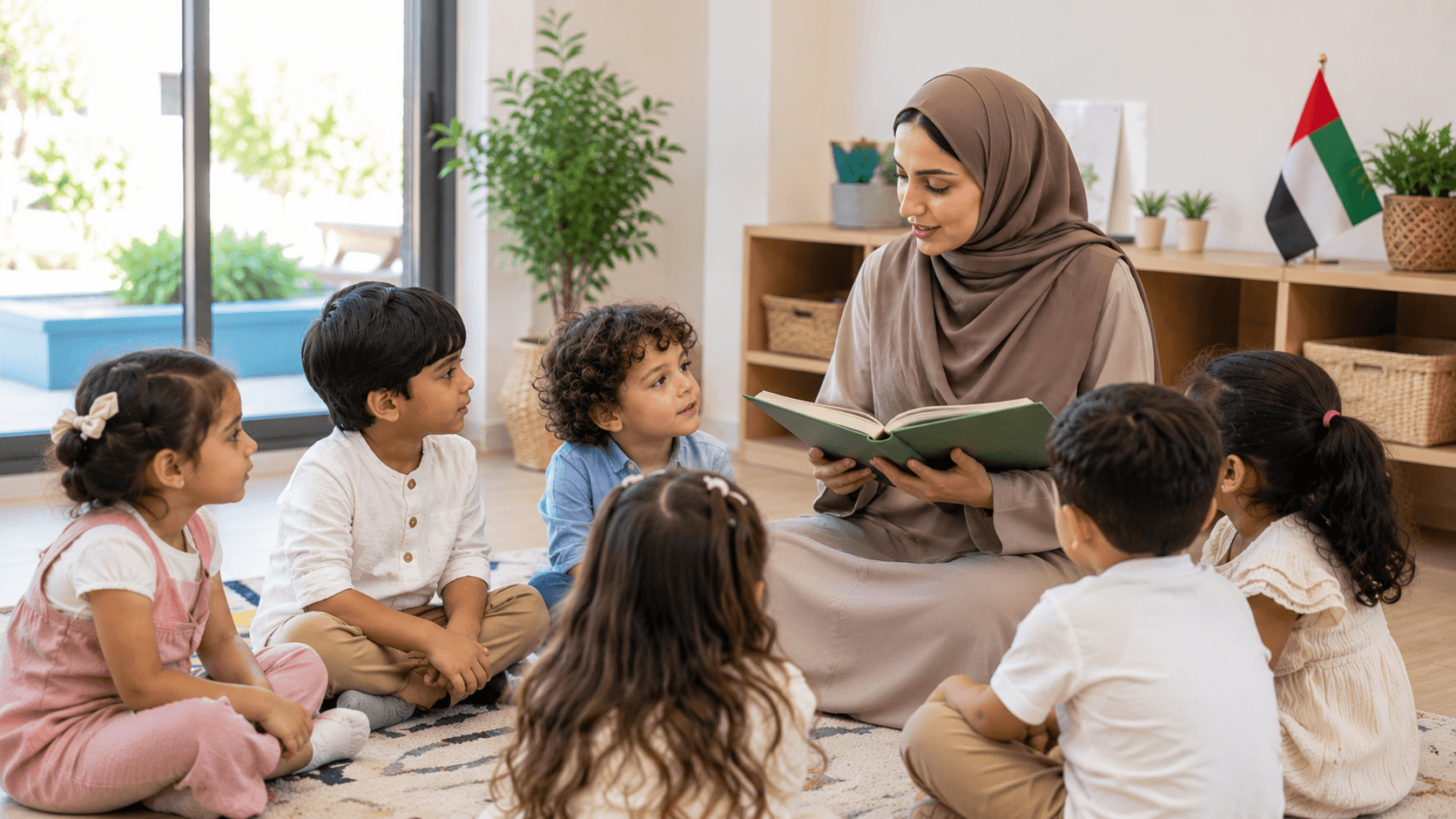
The UAE is preparing a federal Arabic Language Law for introduction by 2027, alongside a phased increase in mandatory Arabic teaching across private schools and nurseries. For parents, this is one of the most significant curriculum changes in the country, and it applies to every approved curriculum, every private school, and every emirate.
This article explains what the new law sets out to do, how the existing Arabic teaching requirements are changing, what KHDA has already introduced in Dubai, and what parents can ask their school to clarify now.
This article reflects official announcements from the UAE Ministry of Culture, the Ministry of Education, KHDA, and UAE press reporting as of May 2026. Schools are expected to receive further implementation guidance ahead of each academic year.
What the UAE Arabic Language Law sets out to do
In early 2026, the Ministry of Culture presented a draft Arabic Language Law to the Federal National Council. The law and its executive regulations are expected to be finalised by 2027, with implementation phased in between 2026 and 2027.
The law applies across ten sectors, with education being one of the most directly affected. The other sectors include government transactions, economy and business, culture and media, translation, family and society, technology and digitisation, governance, customer service, and motivation and support mechanisms.
For schools and nurseries, the law sets out four broad objectives:
- Increase the quantity and quality of subjects taught in Arabic across early, general, and basic education
- Set mandatory minimum Arabic teaching requirements in higher education scientific programmes
- Raise hiring, testing, and professional training standards for Arabic language teachers
- Strengthen academic publishing standards in Arabic within UAE institutions
The Ministry of Culture has indicated that the law is expected to include specific penalties and incentives, including fines for non-compliance.
What changes for private schools
The Ministry of Education has already introduced mandatory daily Arabic lessons for kindergarten pupils in private schools. The requirement applies to all private schools in the UAE, across all approved curricula, including British, American, IB, Indian, French, and other systems.
The phased minute requirements are:
| Academic year | Daily Arabic | Weekly total |
|---|---|---|
| 2025–26 | 40 minutes | 200 minutes |
| 2026–27 | 40 minutes | 200 minutes |
| 2027–28 onwards | 60 minutes | 300 minutes |
For Muslim kindergarten pupils, the Ministry has also confirmed a separate Islamic Studies requirement of 90 minutes per week, delivered either as three 30-minute sessions or two 45-minute sessions.
The Ministry of Education will provide instructional frameworks and learning outcomes ahead of each academic year, supported by advisory visits to schools. Formal compliance inspections begin in the 2026–27 academic year, conducted in partnership with KHDA in Dubai, ADEK in Abu Dhabi, and SPEA in Sharjah.
The KHDA early-years policy in Dubai
In parallel with the federal direction, KHDA has introduced a separate policy making Arabic compulsory for children from birth to six years at all private schools and early childhood centres in Dubai.
The KHDA policy is being rolled out in phases:
- Phase one (from September 2025): children aged four to six
- Subsequent phases: extending to younger ages over the coming years
Under the policy, schools and nurseries must:
- Ensure that at least one-third of instructional time includes an Arabic teacher
- Offer varied learning approaches for native and non-native Arabic speakers
- Employ Arabic teachers with proper qualifications and ongoing professional development
- Provide parents with resources and strategies to support Arabic learning at home
Fatma Belrehif, Chief Executive of KHDA's Education Quality Assurance Agency, said: "Arabic is at the heart of the UAE's cultural identity, and it is essential that we instill a love for the language in all our children from the earliest stages."
The position in Abu Dhabi and Sharjah
Abu Dhabi previously mandated four hours of weekly Arabic for nursery and kindergarten pupils in private schools, which sits above the federal 200-minute minimum. ADEK is expected to continue aligning its requirements with the new federal framework and the phased increase to 300 minutes from 2027–28.
SPEA in Sharjah is expected to follow the same federal framework, with implementation supported through Ministry of Education guidance.
What this means for your child, by age group
Children in nursery and pre-KG
The federal 40-minute daily Arabic requirement formally applies to kindergarten, but the KHDA policy in Dubai already extends to children from birth in nurseries and early childhood centres. Parents of nursery-aged children in Dubai should expect Arabic to feature meaningfully in daily activities.
Children in kindergarten (KG1 and KG2)
Forty minutes of Arabic per day is already in effect for the 2025–26 academic year, regardless of curriculum. Muslim pupils additionally receive 90 minutes of Islamic Studies per week. This will rise to 60 minutes of Arabic per day from the 2027–28 academic year.
Primary, middle, and secondary pupils
Arabic remains a mandatory subject for all pupils in private schools, in line with long-standing Ministry of Education requirements. The new Arabic Language Law is expected to raise the quality and quantity of Arabic teaching in general and basic education, with detailed requirements to be confirmed as the executive regulations are finalised.
What to ask your school now
Ahead of the 2026–27 academic year, parents can confirm the following with their school:
- How the school is delivering the current 40-minute daily Arabic requirement, and how lessons are structured for non-native speakers
- How the school plans to move to 60 minutes per day from 2027–28
- What resources are provided to support Arabic learning at home
- How Arabic teachers are recruited and supported in their professional development
- For Dubai parents, how the KHDA one-third instructional time requirement is being met in early years
- For Muslim families, how the 90-minute weekly Islamic Studies requirement is scheduled
Why this matters for school choice
Arabic provision is becoming a meaningful differentiator between schools. Two schools following the same curriculum can take very different approaches to Arabic, particularly for non-native speakers, ranging from immersive, play-based models to more traditional textbook teaching. Parents choosing a school for 2026–27 or 2027–28 should ask about the school's approach to Arabic alongside its curriculum, fees, and inspection rating.
Frequently Asked Questions
When does the UAE Arabic Language Law take effect?
The Arabic Language Law was approved for drafting in 2026 and is targeted for introduction by 2027. Executive regulations will be finalised over the same period, with phased implementation across ten sectors including education.
How many minutes of Arabic per day are required in UAE private schools?
Kindergarten pupils in all UAE private schools receive 40 minutes of Arabic per day, totalling 200 minutes per week, from the 2025–26 academic year. This rises to 60 minutes per day, totalling 300 minutes per week, from the 2027–28 academic year.
Does the Arabic requirement apply to all curricula in the UAE?
Yes. The Ministry of Education requirement applies to all private schools in the UAE, across all approved curricula, including British, American, IB, Indian, French, and other systems.
Is Arabic mandatory in Dubai nurseries?
Yes. Under the KHDA early-years policy, Arabic is compulsory for children from birth to six years at all private schools and early childhood centres in Dubai. Phase one covers children aged four to six from September 2025, with subsequent phases extending to younger ages.
Do non-Arab and non-Muslim children also have to learn Arabic?
Yes. The federal Arabic teaching requirement applies to all pupils regardless of nationality or religion. Schools are expected to offer varied learning approaches for non-native Arabic speakers.
What happens if a school does not comply with the Arabic requirements?
The Ministry of Education conducts advisory visits and begins formal inspections from the 2026–27 academic year, in partnership with KHDA, ADEK, and SPEA. The forthcoming Arabic Language Law is expected to include specific penalties and incentives, with fines for non-compliance.
How is Islamic Studies handled in kindergarten?
Muslim kindergarten pupils in private schools receive 90 minutes of Islamic Studies per week, delivered as either three 30-minute sessions or two 45-minute sessions, separate from the daily Arabic requirement.